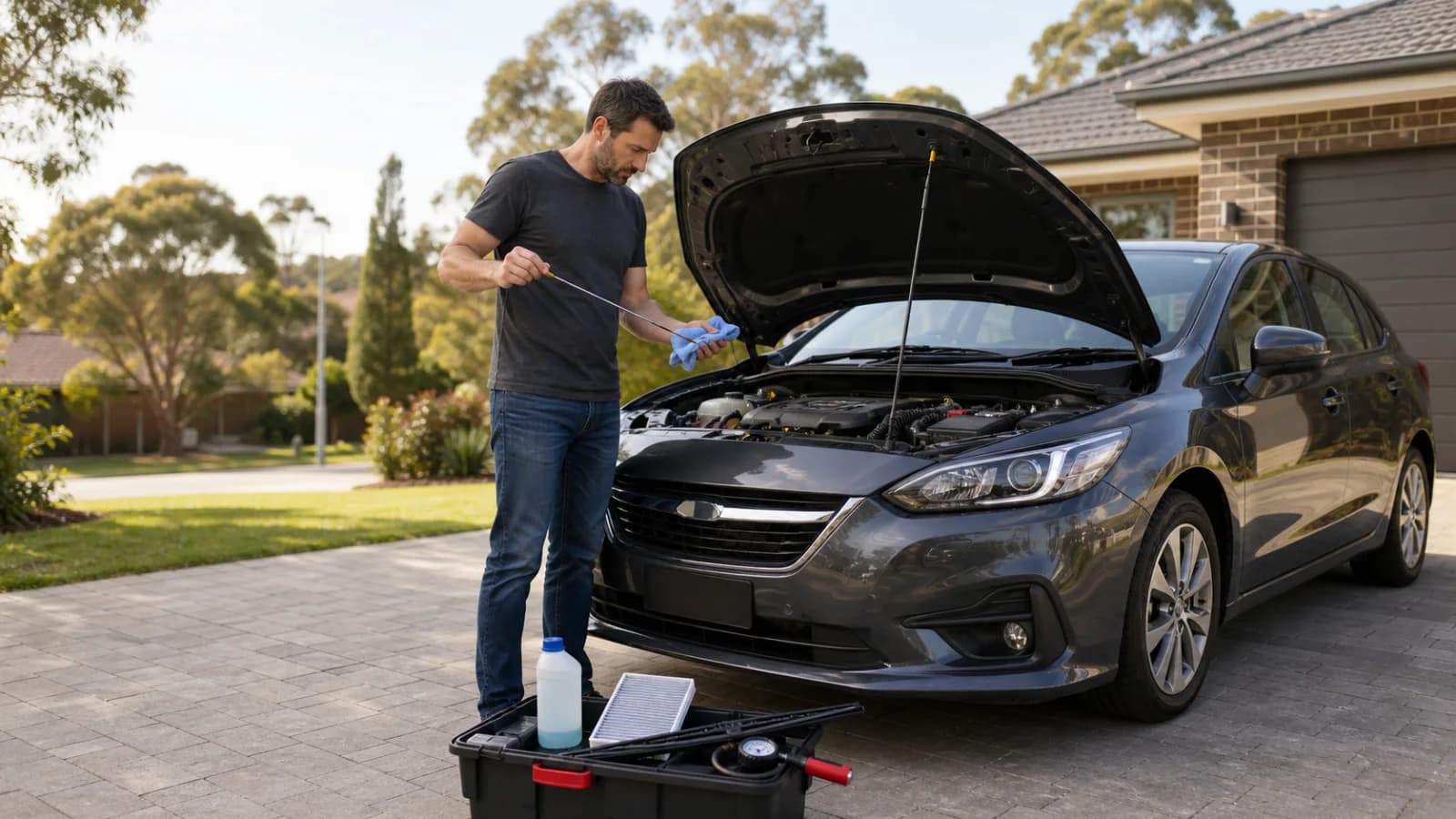
THE SHORT VERSION
Wipers, basic level checks, filters, tyre pressures and a key-fob battery are approachable on many cars. Bulbs, batteries, fuses, oil and spark plugs become model-dependent quickly. Follow the handbook, count only jobs that are actually due and stop before a simple saving becomes an expensive repair.
Workshop labour pays for training, equipment, diagnosis, insurance and responsibility for the result. That is valuable when the job needs it. It can still make sense to handle a few simple replacements yourself when the procedure is clear and the risk is low.
This guide covers typical passenger cars. Your owner’s handbook and the manufacturer procedure take priority. Some wipers need a service position, some batteries need electronic registration, and some “bulbs” are sealed LED assemblies. A five-minute video for a similar-looking model is not a substitute for the correct procedure for your exact car.
| JOB | WHEN TO CONSIDER IT | TIME | LEVEL |
|---|---|---|---|
| 1. Wiper blades | When performance drops | 5–15 min | Easy |
| 2. Fluid levels | Monthly and before a long trip | 5 min | Easy |
| 3. Engine air filter | Follow the service schedule | 10–20 min | Easy |
| 4. Cabin filter | Follow the service schedule | 10–30 min | Easy |
| 5. Tyre pressures | Monthly and before a long trip | 10 min | Easy |
| 6. Tread and tyre rotation | Inspect monthly; rotate to schedule | 5–45 min | Mixed |
| 7. Battery terminals | Inspect every six months | 10–20 min | Cautious |
| 8. 12-volt battery | When testing shows replacement is due | 20–60 min | Model-dependent |
| 9. Replaceable light globes | As needed | 10–30 min | Model-dependent |
| 10. Key-fob battery | When range or warning changes | 2–10 min | Easy |
| 11. Blade fuses | After diagnosis | 5–15 min | Cautious |
| 12. Engine oil and filter | Follow the service schedule | 45–90 min | Advanced |
| 13. Spark plugs | Follow the service schedule | 60+ min | Advanced |
| 14. Small paint chips | As soon as practical | 20+ min | Easy |
Before you touch the car
- Read the handbook and find the procedure, compatible part, fluid specification, lifting point and torque value you need.
- Work on firm, level ground with the ignition off. Let hot or moving components cool and keep loose clothing clear.
- Protect your eyes and skin around batteries, fluids, dust and pressurised systems. Clean spills immediately.
- Never go beneath a car supported only by a jack. Use rated stands or ramps correctly, chock the wheels and follow the manufacturer’s lifting instructions.
- On an EV or hybrid, never touch orange high-voltage cables or components. The 12-volt system can also have model-specific shutdown and wake-up procedures.
Five approachable driveway jobs
1. Replace tired wiper blades
Clean the windscreen and blade edges first. Replace a blade when the rubber is split, curled or loose, or it still streaks, skips or leaves missed areas on wet glass. Check whether the car needs wiper service mode before lifting the arms. Put a folded towel on the glass and never let a bare metal arm snap down.
Match the blade lengths and connector to the exact vehicle. After fitting, check that every connector is locked and test the blades on a wet windscreen.
THE EASY FIRST JOB
We match a complete AeroBeam set to your exact make, model and year.
2. Check the fluid levels
Park level and follow the handbook’s cold- or warm-engine instructions. Check the engine oil using the specified method; inspect the coolant expansion bottle without opening a hot, pressurised cooling system; use the recommended washer product; and visually inspect the brake-fluid reservoir without opening it unnecessarily.
A falling level matters more than a one-off top-up. Low brake fluid, recurring coolant loss, rapidly falling oil or any unidentified leak needs diagnosis. Do not keep adding fluid to hide a fault.
3. Replace the engine air filter
Use the service interval and severe-use conditions in the handbook. Open the airbox without letting debris fall into the intake, note the filter orientation, clean the sealing surface and make sure the replacement sits flat before fastening the lid. A sunlight test is not a reliable way to decide whether a modern filter is serviceable.
4. Replace the cabin filter
Many cabin filters sit behind the glovebox, but access can involve clips, dampers or trim that break if forced. Follow the correct procedure and airflow arrow. A blocked filter can reduce airflow; a persistent musty smell may instead come from the evaporator, drain or moisture elsewhere in the system.
5. Set the tyre pressures
Check every tyre, including an accessible spare, with an accurate gauge while cold—ideally before driving or after the car has been parked for at least three hours. Use the vehicle placard or handbook figure, not the maximum printed on the tyre. If a loaded pressure is specified, use that figure for the load; do not add an arbitrary 2–4 psi.
Pressure naturally rises as a tyre warms. Do not bleed a warm tyre down to the cold placard figure; recheck it cold. Proper inflation improves safety and tyre life. The US Department of Energy reports an average fuel-economy improvement of about 0.6%, and up to 3%, from correcting underinflation—not a guaranteed 3% saving for every driver. See its efficient-driving guidance.
Six jobs that depend on the car
6. Check tread and plan rotation
Inspect the tread and sidewalls for cuts, bulges, cracking, embedded objects and uneven wear. Victoria requires at least 1.5 mm in the principal grooves and says the tread must not be worn to the point that an indicator contacts the road. Read the Transport Victoria tyre requirements and confirm the rules in your jurisdiction.
Rotation patterns depend on whether the tyres are directional, staggered or differently sized front to rear. If you have the correct lifting equipment and procedure, tighten the wheels to specification with a torque wrench and perform any required recheck. Otherwise, ask a tyre shop to rotate and inspect them. Uneven wear can point to an alignment, pressure or suspension issue that rotation will not fix.
7. Clean battery terminals
Corrosion on the outside of conventional 12-volt battery terminals can increase resistance. Before disconnecting anything, check whether the vehicle needs a memory, alarm or shutdown procedure. Wear eye protection and gloves, keep flames and sparks away, disconnect negative first and reconnect it last. Keep cleaning solution and debris out of vents and cells.
Resting voltage mostly shows state of charge; it does not prove battery capacity or starting health. A low reading deserves charging and a proper load or conductance test, not an automatic replacement.
8. Replace the 12-volt battery
Replacement is reasonable only when access and the manufacturer procedure are straightforward. Match the case, terminal layout, rating and chemistry. Stop-start cars may need an AGM or EFB battery, and many newer vehicles require battery monitoring to be reset or the new battery registered. Batteries are heavy and can contain corrosive acid; secure the hold-down correctly and recycle the old unit through an approved service.
9. Replace accessible light globes
Confirm the exact globe and access procedure, switch the lights and ignition off, and avoid touching halogen glass. Test every function after refitting. Sealed LED assemblies, difficult bumper-off access and high-voltage HID systems are not simple globe swaps and may be better handled professionally.
10. Replace the key-fob battery
Use the handbook to release the emergency key, open the case at the intended point and match the exact coin-cell code and polarity. CR2032 is common, not universal. Learn the emergency unlock and backup starting procedure too; many vehicles can still be opened and started when the fob battery is flat.
11. Replace a diagnosed blade fuse
A blown fuse is evidence of overcurrent, not proof that the fuse itself caused the problem. Turn the affected circuit and ignition off, use the fuse map and replace only with the same type and amperage. Never fit a larger fuse. If the replacement blows or there is heat, a smell or damaged wiring, stop and have the circuit diagnosed.
Three jobs with less room for error
12. Change the engine oil and filter
An oil change is not a complete service. Before starting, know the exact oil specification and quantity, filter, drain-plug torque, sealing-washer requirement, lifting method and complete service schedule. Support the vehicle correctly, protect yourself from warm oil, start the plug and filter without cross-threading, check the final level by the specified method and inspect for leaks after running the engine.
Keep records and dispose of oil responsibly in a sealed, oil-safe container. Supercheap Auto currently accepts household quantities at participating stores; Repco says it does not currently provide in-store oil recycling. Check availability before travelling or use your council facility. See Supercheap Auto’s conditions and Repco’s disposal guidance.
13. Replace accessible spark plugs
Work on a cold engine and follow the exact sequence. Clean loose debris from around the wells before removing anything, keep coils and connectors in order, start every plug by hand and use the specified torque. Do not assume a pre-gapped fine-wire plug should be adjusted. If access requires removing an intake manifold or the procedure is unclear, this is no longer a one-hour beginner job.
14. Protect a small stone chip
A paint-code-matched touch-up product can protect a clean, shallow stone chip. Wash, dry and prepare the area as the paint maker directs, then build thin dabs rather than flooding the chip. Existing rust needs correct removal and treatment first. Deep scratches, dents, peeling clear coat and large damaged areas need a different repair; a paint pen is not equivalent to professional refinishing.
Calculate your number, not ours
There is no defensible universal “$700 every year” figure. A battery may last several years, globes may not fail at all, and filters follow the vehicle schedule rather than the calendar. A fitted workshop price can also include inspections that a parts-only comparison misses.
- Count only jobs that are actually due this year.
- Compare like with like: an oil change is not the same product as a complete scheduled service.
- Amortise reusable tools over the jobs you realistically plan to do; they do not become economically “free”.
- Put a value on professional diagnosis when a symptom has more than one possible cause.
When not to DIY
- Brakes: leave hydraulic work and any repair you are not trained and equipped to verify to a qualified repairer.
- Airbags and SRS: stored energy and deployment risk make casual diagnosis a bad idea.
- EV and hybrid high voltage: never work on orange cables or high-voltage components without the required training and isolation procedure.
- Air-conditioning refrigerant: work that risks releasing a controlled refrigerant requires the appropriate authorisation. Leave regassing and refrigerant diagnosis to a properly equipped business. See the Australian Refrigeration Council licence guidance.
- Steering, suspension and timing work: use a qualified repairer when you cannot follow the complete procedure and verify the result.
- Warranty uncertainty: check the warranty terms before owner-performed scheduled servicing. The ACCC confirms that consumers can choose an independent repairer, but that does not make every DIY repair automatically compliant with every warranty condition. Read current ACCC car guidance.
Six recommendations worth clarifying
- Engine flush: ask what condition or manufacturer instruction makes it necessary now.
- Fuel-system cleaning: ask whether it addresses a diagnosed symptom, scheduled item or measured fault.
- Air filter: ask whether it is due by the schedule or damaged or restricted, rather than judging it by colour alone.
- Wiper blades: ask for the fitted price and compare it with a correctly matched DIY set.
- Nitrogen inflation: ask what practical benefit it provides for your use and remember it does not remove the need for pressure checks.
- Cabin filter: ask for the part and labour split, then check how involved the correct procedure is on your car.
THREE USEFUL QUESTIONS
- “Can you show me what you found?”
- “Is this urgent, due soon or optional?”
- “What is likely to happen if I wait until the next service?”
DIY car maintenance FAQs
How much can DIY car maintenance save?
It depends on the car, what is actually due, local fitted prices and the tools you already own. Compare a written fitted quote with the exact cost of compatible parts, consumables, tools and disposal. Do not count a battery, globe, filter or key-fob battery every year unless it genuinely needs replacement.
Can I service my own car without voiding the warranty?
Australian Consumer Law rights and a manufacturer or dealer warranty are different. Manufacturer warranties commonly allow a choice of repairer when servicing meets the required standard, but owner-performed work is not automatically covered by the same wording. Check the warranty conditions, follow the service schedule and specifications, and keep detailed records. A dealer or extended warranty may have additional conditions.
Which car-maintenance jobs should I not do myself?
Leave work alone when it involves a high-voltage EV or hybrid system, airbags, controlled refrigerant, a safety-critical system you are not trained to assess, or going beneath a car without correct lifting equipment. Brakes, steering and suspension deserve particular caution. Stop whenever the manufacturer procedure, tools or torque specifications are unavailable.
How often should I check tyre pressure?
A monthly check and another before a long trip is a useful routine. Use the vehicle placard or handbook pressure while the tyres are cold; do not use the maximum figure on the tyre sidewall. Use the manufacturer’s loaded pressure when one is specified for your load.
Is an oil change the same as a car service?
No. Oil and filter replacement may be one scheduled item, but a proper service can also include inspections, diagnostics, adjustments and other time- or distance-based replacements. Follow the complete schedule for the exact vehicle.
START WITH THE FIVE-MINUTE JOB.
Tell us your make, model and year. We’ll match a complete set of AeroBeam wipers with the correct connectors already fitted.
FIND WIPERS FOR MY CAR