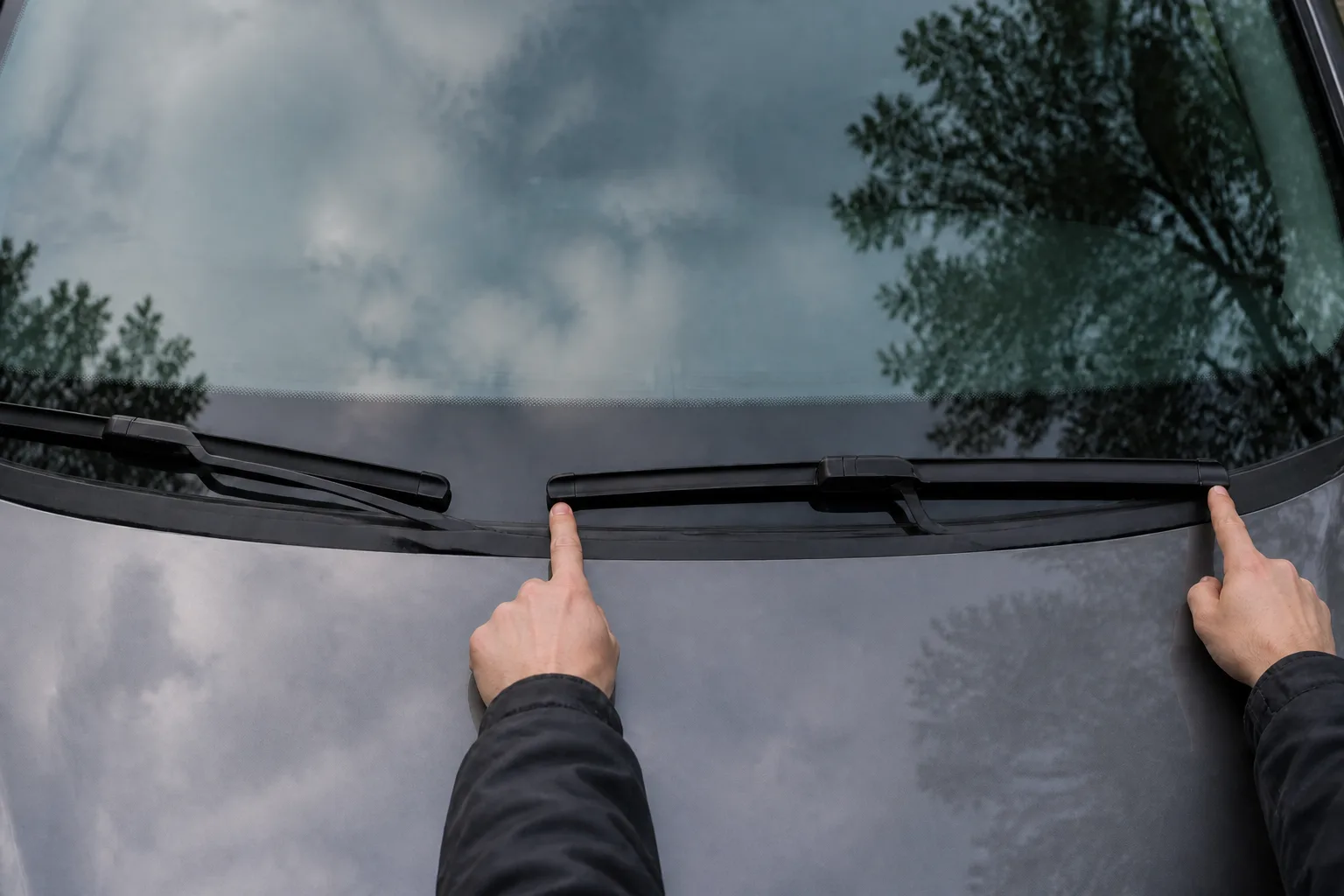
A WIPER SIZE IS AN ENGINEERING SPEC, NOT A PREFERENCE.
Each blade length is set so the arm’s fixed sweep clears the required area of glass, stays clear of the pillar trim and the other blade, and keeps the arm’s spring pressure high enough to hold the rubber on the screen at highway speed. A blade that is too long hits things and lifts. A blade that is too short leaves a permanent unwiped band. Swapping sides does both at once. The fix is to match the driver, passenger and rear sizes—and the connector—to the exact vehicle.
Wiper blades look interchangeable, and that is the problem. Length is printed on the pack as if it were a shoe size, so “close enough” feels reasonable. It is not. This guide sets out what the wrong size does to the car, why the numbers are what they are, and how often the size changes between cars that look the same—using the Prowiper fitment catalogue as the dataset.
WHY THE SIZES ARE WHAT THEY ARE.
Manufacturers do not pick blade lengths by eye. Vehicles type-approved in Europe—a framework many of the global models sold here are also engineered against—must have a wiper field that covers at least 98% of vision area A and 80% of vision area B—the two zones of glass defined around the driver’s eye position. The same regulation requires the blades to stay in contact with the glass, with no lift-off, at 80% of the vehicle’s maximum design speed or 160 km/h, whichever is lower.
Those two requirements pull in opposite directions. Coverage wants a long blade; contact pressure and clearance want a short one. The specified lengths for each side are the resolution of that trade-off for one particular windscreen curvature, arm geometry, spring force and sweep angle. Change the length and you re-open the trade-off without any of the tools used to settle it.
The pressure part is easy to underestimate. The arm’s spring supplies a fixed pressing force; engineers describe the result as a contact force per metre of blade. Research on wiper aerodynamics shows that force declines as speed rises and lift builds, with one cited study putting lift at 9.8 N on a conventional blade at 160 km/h. A longer blade divides the same spring force over more rubber, so it starts with less pressure per millimetre and lifts sooner. Contact along the blade is also sensitive to the beam’s curvature and stiffness, which is why a blade is matched to a specific screen rather than sold as “any 600 mm will do”.
Australia’s current design rule for wipers, ADR 42/05, is brief: a power-driven wiping system and a washer that lands inside the swept area. The in-service rules are outcome based. Under the NSW light-vehicle standards, mirrored in the other states’ vehicle standards rules, a wiper must clear the windscreen in front of the driver and, on a car with an offset driving position, a corresponding part on the other side of the centre line. A short passenger blade fails that test on the left-hand side of the screen.
WHAT 2,894 AUSTRALIAN FITMENTS SHOW.
We analysed the Prowiper fitment catalogue on 2 September 2026: 3,017 vehicle fitments sold in Australia, of which 2,894 resolve a complete driver and passenger front pair. It is not a survey of what is fitted to cars on the road; it is the specified sizes, which is what tells you how much room there is for guesswork.
75.7%
of fitments use two different front lengths
2,190 of 2,894 front pairs. Only 24.3% are a matched pair.
97.4%
of mismatched pairs put the longer blade on the driver’s side
The other 2.6%—mainly MINI, Mercedes-Benz, Porsche and Peugeot—run the longer blade on the passenger side.
49.4%
of fitments differ by 100 mm or more between sides
The median gap is 75 mm. One in nine (11.4%) differ by 250 mm or more.
18 × 16
front lengths × arm connectors in the catalogue
Lengths run from 300 mm to 750 mm. The 600 mm blade alone is paired with 15 different connectors.
The size also moves between generations of the same badge. Of the 552 model lines in the catalogue with more than one fitment, 63.8% changed a front length between generations or body styles, 37.3% changed the arm connector, and 69.0% changed at least one of the two. Four popular examples:
| GENERATION | DRIVER | PASSENGER |
|---|---|---|
| Toyota Corolla sedan | ||
| E120 · 2000–2008 | 600 mm | 450 mm |
| E150 · 2006–2014 | 650 mm | 400 mm |
| E170 · 2012–2019 | 650 mm | 350 mm |
| E210 · 2019–2026 | 700 mm | 350 mm |
| Ford Ranger | ||
| PK · 2009–2011 | 450 mm | 450 mm |
| PX Mk1 · 2011–2015 | 600 mm | 400 mm |
| PX Mk2–3 · 2015–2022 | 600 mm | 400 mm * |
| PY · 2022–2026 | 625 mm | 425 mm * |
| Holden Commodore | ||
| VZ · 2004–2006 | 550 mm | 500 mm |
| VE–VF · 2006–2017 | 650 mm | 375 mm * |
| ZB · 2017–2020 | 600 mm | 500 mm * |
| Hyundai i30 | ||
| FD hatch · 2007–2012 | 600 mm | 450 mm |
| GD hatch · 2011–2017 | 650 mm | 350 mm |
| PD hatch · 2016–2025 | 650 mm | 400 mm |
| CN7 sedan · 2020–2026 | 600 mm | 450 mm |
* Arm connector also changed from the previous generation. Nominal sizes from the Prowiper catalogue at 25 mm per inch; sedan and hatch variants of the same generation often differ.
Two details from the table are worth holding onto. A 2005 Corolla sedan and a 2020 Corolla sedan share a name and a 100 mm difference on both blades—in opposite directions. And the Ford Ranger went from a matched 450 mm pair to a 600 mm / 400 mm split in a single generation change, then changed connector twice while the lengths barely moved. Neither the old blade nor the model name tells you what the car needs.
TOO LONG: FIVE THINGS THAT GO WRONG.
Longer feels like more coverage. In practice it is the same sweep with a tip that travels further and rubber that presses less. These are the failure modes, in the order you usually notice them.
It reaches the A-pillar or bonnet trim
The arm sweeps through a fixed arc. Add length to the blade and the tip travels further at the top of that arc. On many cars the design margin between the tip and the pillar mould is small; once it is used up, the end cap taps trim on every cycle, chips paint and tears the rubber.
The two blades collide
On the common overlapping-sweep layout, the driver and passenger blades pass close to each other mid-screen. A longer passenger blade pushes into the driver blade’s path. Frames touch, the blades lift, and the driver’s side is left streaked in exactly the zone you look through.
It hangs past the glass when parked
The park position sits just above the cowl. Extra length can leave the tip resting on the cowl panel or a bonnet edge. Rubber that is parked on plastic or paint rather than glass deforms and takes a set—so it streaks even before the frame damage shows.
It loses contact pressure
The arm’s spring delivers a fixed pressing force sized for the specified blade length. Spread that force along a longer rubber edge and the pressure per millimetre falls, which is the same effect aerodynamic lift has at speed. Curved passenger-side glass makes this worse: a longer blade bridges the curve instead of following it, and the ends float.
It loads the linkage and motor
A longer blade carries more friction, more rubber drag and more wind load through the same arm, spindle and linkage. That is added wear even when nothing visibly hits, and it turns into stalling or a burnt-out motor if the blade does snag trim or the other blade.
TOO SHORT: THE QUIET FAILURE.
A short blade does not make noise or hit anything, so it is the mistake that stays on a car for years. It shows up as a band of glass that is wet when the rest is clear.
A permanent unwiped band appears
The wiped field is engineered around the specified lengths. Take 50 mm off the driver blade and a strip of the glass at the outer end of the sweep—or along the bottom of the arc—never gets cleared. In rain at night that strip is exactly where reflections and spray sit.
The passenger side stops doing its job
On a right-hand-drive car the passenger blade clears the left of the screen: the kerb, cyclists and traffic entering from a side street. Australian vehicle standards require a wiper to clear a corresponding area on the other side of the centre line, not just the patch in front of the driver.
Pressure is concentrated, not spread
The same spring force on a shorter edge means higher pressure per millimetre. That accelerates rubber wear, encourages chatter on a dry-ish screen and can leave fine arc marks in road film that look like scratches.
The mismatch usually hides a second error
A blade that is “a bit short” has often been chosen by measuring the old one, and the old one may itself have been wrong. In our catalogue 63.8% of model lines change length between generations, so a size that was right for the last generation is a guess for this one.
SWAPPED SIDES AND SAME-SIZE PAIRS.
Because 75.7% of fitments use two different lengths, the most common size mistake is not a wrong number—it is the right two numbers on the wrong arms, or two of the same number. Fit the 650 mm blade where the 400 mm belongs and you get every too-long problem on the passenger side (pillar contact, blade clash, bridging the curve) and every too-short problem on the driver’s side, in the zone you look through.
Same-size pairs are the retail version of the same error. Only 24.3% of Australian fitments in our catalogue specify a matched pair, so a “set of two 550 mm blades” is wrong for three cars in four. The direction of the mismatch is not a safe assumption either: 97.4% of split fitments put the longer blade on the driver’s side, but MINI, Mercedes-Benz, Porsche and Peugeot models in particular do the reverse.
Connector errors belong in the same category. The 600 mm blade in our catalogue is paired with 15 different arm connectors. A blade that is the right length on the wrong connector sits at the wrong angle, rocks on the arm or never locks, and the symptoms—streaks, chatter, lift, a blade that flies off on the freeway—are indistinguishable from a length error. For the connector side of the story, see what wiper blades fit my car.
GET BOTH SIZES AND THE CONNECTOR RIGHT.
Prowiper matches the driver, passenger and rear lengths to your exact make, model, year and body style, and ships the connector already fitted. Wrong fit is replaced free.
FIND MY EXACT FITWHY IT MATTERS IN THE WET.
Wiper size is a visibility question, and visibility in rain is where a large share of weather-related crashes happen. The US Federal Highway Administration’s 2019–2023 averages show 12% of all crashes occurring in adverse weather, with over 77% of those in rain or mist and rain accounting for 74% of weather-related deaths. In Australia, an analysis of Victorian police crash records found weather involved in at least 10% of fatal and 9% of casualty crashes, a figure the authors consider an underestimate because subtle conditions are rarely recorded.
None of those studies isolate wiper size, and we will not pretend they do. What the research does show is that the wiper’s condition changes what a driver can see: in a 40-driver night-driving experiment under artificial rain, wiper condition measurably affected object detection and sign reading. A blade that leaves a permanent unwiped band, or lifts at 100 km/h, is a wiper in poor condition by design—every time it rains, not just when the rubber ages.
HOW THE WRONG SIZE GETS ON THE CAR.
- 1
Measuring the old blade.
The previous owner or a quick roadside fit may have left the wrong size on the car. A tape measure copies the mistake.
- 2
Buying two of the same length.
Three in four Australian fitments use two different front lengths. A “pair” of identical blades is wrong for most cars.
- 3
Going by model name alone.
Among 552 model lines with more than one generation in our catalogue, 63.8% changed length and 37.3% changed connector between generations. Two thirds (69%) changed at least one.
- 4
Rounding up “for more coverage”.
The gap between the top of the sweep and the pillar trim is a design margin, not spare capacity. It is also the first thing a longer blade uses up.
- 5
Treating the rear as a short front blade.
45.9% of fitments in our catalogue include a rear blade, and rears commonly use a dedicated arm or connector. A short front blade forced onto a rear arm is both the wrong size and the wrong fit.
- 6
Universal packs and multi-adaptor kits.
A blade sold as “fits most” has to compromise on length, curvature or connector. The compromise is usually made on the passenger side, where curvature is greatest.
CHECK YOUR CAR IN FIVE MINUTES.
You do not need to remove anything. Six observations tell you whether the blades currently on the car are the right size and sitting the way they should.
- Check the park position. With the wipers off, both tips should rest on glass, clear of the cowl and bonnet edge. A tip on plastic or paint is a length or arm-position problem.
- Watch a full wet cycle from outside. Wet the screen and run one slow cycle. The driver tip should stop short of the A-pillar trim without touching it, and the two blades should never make contact.
- Look for the unwiped bands. From the driver’s seat, look for a strip along the outer edge or the base of the sweep that stays wet. That band is the shortfall.
- Listen and feel at speed. A blade that is fine at 40 km/h but chatters or lifts at 100 km/h has lost pressure. Check length and connector fit before blaming the rubber.
- Rock the blade on the arm. Hold the arm and try to move the blade side to side. Any play means the connector is wrong or not locked. That is a size problem too—the wrong connector never seats at the intended angle.
- Compare against the listed fitment. Look up your exact make, model, year and body style. If the lengths on the car do not match the listed driver and passenger sizes, the car is carrying the wrong blades—whoever fitted them.
FOUND A MISMATCH?
Browse the specified driver, passenger and rear sizes for every make and model we stock.
WRONG SIZE WIPER FAQS.
Can I fit a longer wiper blade to clear more of the windscreen?
No. The arm sweeps a fixed arc, so a longer blade does not widen the wiped area usefully; it pushes the tip towards the A-pillar trim, the other blade and the cowl. The arm spring is also sized for the specified length, so the extra rubber runs at lower pressure and lifts sooner at speed. Fit the listed driver and passenger sizes.
Is 25 mm (one inch) shorter or longer close enough?
Treat one size step as a real change, not a rounding error. One step longer is often the whole clearance margin at the pillar or between the blades. One step shorter leaves a 25 mm strip at the end of the sweep that never gets cleared. Some catalogues list a nominal size that differs slightly from the factory blade for the same fitment; that is an engineered equivalent, which is different from choosing a size yourself.
Can I use the same length on both sides?
Only if the car specifies it. In Prowiper’s catalogue 75.7% of Australian fitments use two different front lengths, and the median difference is 75 mm. Two identical blades will be too long on one side or too short on the other for three cars in four.
Which side gets the longer blade?
Usually the driver’s side—97.4% of mismatched fitments in our catalogue—but not always. A small group of vehicles, mainly MINI, Mercedes-Benz, Porsche and Peugeot models, run the longer blade on the passenger side. Follow the listed positions for your exact vehicle rather than a rule of thumb.
Will the wrong size wiper blade damage my car?
It can. Common outcomes are chipped paint and scuffed trim on the A-pillar or cowl, torn rubber and bent frames from blade-to-blade contact, and extra load on the wiper linkage and motor. A blade that hangs past the glass when parked also deforms and streaks early. None of these are guaranteed, but all of them are avoidable.
My wipers hit the A-pillar but the blades are the right length. Why?
Check the arm, not the blade. Arms sit on a splined spindle and can be refitted one spline high after a windscreen replacement or repair, which moves the whole sweep towards the pillar. Worn linkage on older cars can also widen the sweep. Have the arm position and contact pressure checked before changing blade sizes.
Does the connector count as part of the size?
For fitment purposes, yes. The same 600 mm blade is paired with 15 different arm connectors in our catalogue. A blade that is the right length but the wrong connector will sit at the wrong angle, rock on the arm or refuse to lock, and can detach on the move. Match length, position and connector together.
SOURCES.
| SOURCE | WHAT IT SUPPORTS |
|---|---|
| Regulation (EU) No 1008/2010 | Type-approval rule for windscreen wiper systems: the wiped field must cover at least 98% of vision area A and 80% of area B, and the blades must not lift off the glass at 80% of the vehicle’s maximum design speed or 160 km/h, whichever is lower. |
| Australian Design Rule 42/05 | Every vehicle with a windscreen must have a power-driven wiping system, and a washer that delivers water within the area swept by the wiper. ADR 42 absorbed the earlier ADR 16 wiper rule. |
| NSW Light Vehicle Standards, cl. 45 | In service, a wiper must remove moisture from the part of the windscreen in front of the driver—and, for an offset driving position, a corresponding part on the other side of the centre—so the driver has an adequate view of the road. |
| Çadirci et al., 2017 | Engineering study of wiper aerodynamics: the arm spring supplies the pressing force, that force declines with speed as lift builds, and earlier work put lift at 9.8 N for a conventional blade at 160 km/h. Length, height and spoiler geometry all change the result. |
| Lee et al., 2013 | Finite-element and test study showing contact force along the blade depends on the beam’s curvature and stiffness—which is why a blade’s length and curve are matched to a specific screen, not chosen freely. |
| US Federal Highway Administration | 2019–2023 averages: 12% of crashes are weather-related, over 77% of those occur in rain or mist, and rain accounts for 74% of weather-related deaths. |
| Journal of Road Safety (Victoria) | Analysis of Victorian police crash records found weather involved in at least 10% of fatal and 9% of casualty crashes—described by the authors as an underestimate. |
| Accident Analysis & Prevention, 2014 | In a 40-driver night-driving experiment under artificial rain, wiper condition measurably changed visual performance on a detection and sign-reading task. |
RESEARCH NOTE
The catalogue figures are Prowiper’s own specified fitments for vehicles sold in Australia, analysed on 2 September 2026. They describe how often sizes and connectors differ, not how many cars on the road carry the wrong blades—we found no published survey of that. The regulatory sources define what a wiper system must achieve; the engineering papers explain why length, curvature and spring force are tied together; the crash statistics establish that rain is where visibility failures are most costly. No source quantifies crashes caused specifically by wrong-size blades, and this guide does not claim one. Sources were checked on 2 September 2026.
THE RIGHT TWO SIZES. THE RIGHT CONNECTOR.
Choose your make, model and year. We match the driver, passenger and rear lengths to your car and fit the connector before the kit leaves Melbourne.
FIND WIPERS FOR MY CAR