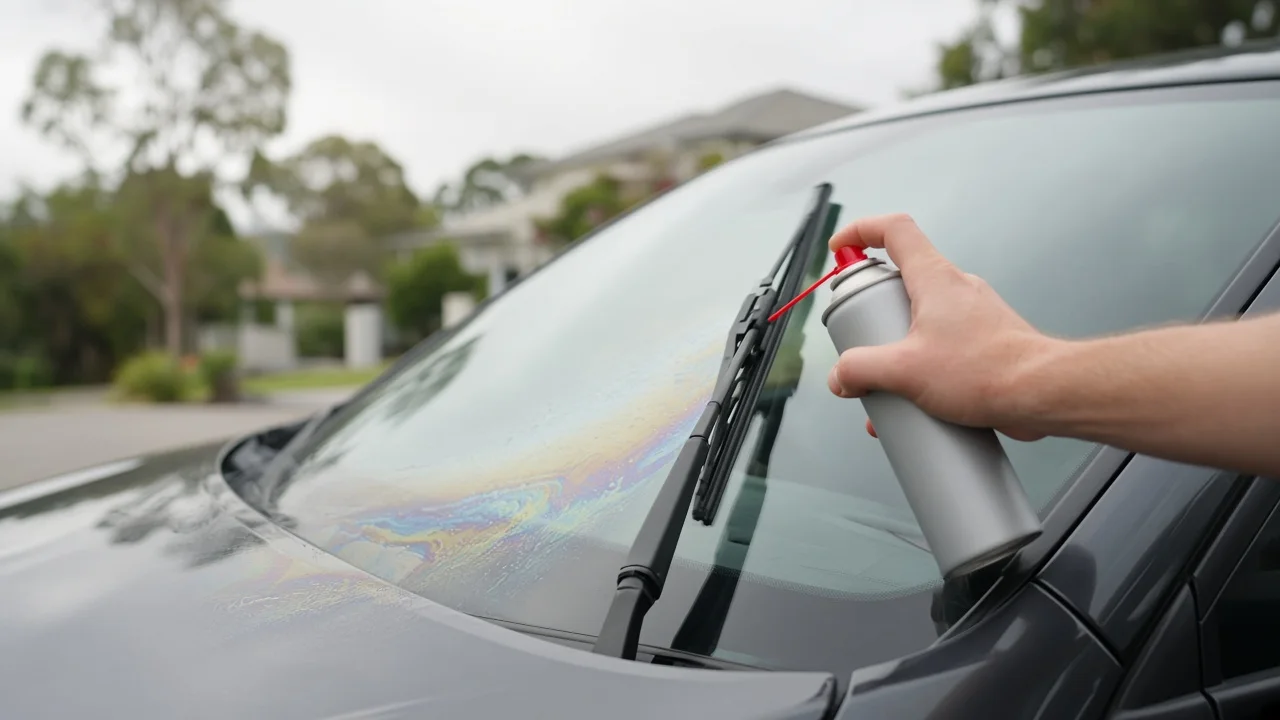
THE SHORT ANSWER
No. WD-40 does not fix squeaky wipers. It masks the noise for a short time by oiling the glass, fixes none of the causes, leaves a smear-prone petroleum film in your line of sight and exposes the rubber to a solvent-and-mineral-oil mix that wiper compounds are rated unsuitable for. Clean the glass properly, clean the rubber, check the fit and arm, and replace the blade if it still squeaks.
The tip is everywhere: a quick spray along the blade, wipe off the excess, silence. It spreads because it is cheap, the can is already in the shed and it genuinely does go quiet for a drive or two. That short-lived result is the whole problem. A wiper squeak is a symptom, and WD-40 treats the symptom by changing the one thing a wiper depends on: controlled friction between clean rubber and clean glass.
This guide separates what the claim gets right from what it gets wrong, using WD-40 Company’s own published material, rubber compatibility data and the diagnostic procedure a vehicle manufacturer gives its own technicians for noisy wipers.
Where the tip came from
The advice is not entirely invented. WD-40 Company publishes a long, crowd-sourced list of uses for its Multi-Use Product, and that list includes “stops squeaking on windshield wipers”, “removes gunk and protects windshield wiper blades” and “spray on windshield wipers in the early summer so the blades don’t crack and dry out”. If you have seen the tip quoted as coming from WD-40 itself, this is the source.
Read the top of that document, though. It opens with a disclaimer that the uses “were provided to WD-40 Company by end-users of the product, and do not constitute recommendations or suggestions for use … by WD-40 Company. These uses have not been tested by WD-40 Company.” In other words, the wiper tip is a user anecdote republished with a legal caveat, not a tested application. You can check it in the WD-40 “2000+ uses” PDF.
The same company’s customer FAQ is more careful. Asked whether the Multi-Use Product can be used on rubber, WD-40 UK says to test in an inconspicuous area first and that “certain types of rubber will swell upon prolonged immersion”. For rubber and plastic parts it steers people to its separate silicone product instead. A wiping edge that lives in a damp film of the product, stroke after stroke, is closer to prolonged exposure than a one-off wipe of a door seal.
Why it seems to work (for about a day)
A wiper squeak is stick-slip vibration. The rubber lip grips the glass, releases, grips again, hundreds of times a second, and the blade and arm resonate. Anything that lowers friction between the lip and the glass interrupts that cycle, which is why a coat of oil produces instant silence. Soapy water does the same thing, and so does simply wetting the screen properly.
The difference is what happens next. Water and detergent rinse away. Petroleum oil does not. The first few wipes spread it across the arc of the blade, rain thins it into a haze, and the blade is now trying to wipe water off a surface that repels water unevenly. Uneven friction is the exact condition that causes chatter in the first place, so the noise comes back, and it brings smearing with it. The squeak was never fixed. It was borrowed against.
What WD-40 actually does to a wiper
1. It puts an oil film exactly where you look
The safety data sheet for WD-40 Multi-Use Product aerosol lists 45–50% low-vapour-pressure aliphatic hydrocarbon, up to 35% petroleum base oil and 10–25% aliphatic hydrocarbon solvent, with carbon dioxide as the propellant. The Australian data sheet describes the same family: hydrotreated light petroleum distillates, petroleum base oils and heavy naphtha. The solvent flashes off. The mineral oil stays, and it stays on the glass.
On a windscreen that means a smear that catches oncoming headlights at night, a rainbow sheen in low sun and water that beads and streaks instead of sheeting cleanly off the glass. Australian in-service rules judge wipers on outcome: the NSW light-vehicle standard requires a wiper to remove moisture so the driver has an adequate view of the road. A blade that is quiet but smears is not meeting that test.
2. It soaks a rubber that is not rated for it
Most wiper blades use natural rubber, a natural and synthetic blend, or EPDM, often with a graphite or chlorinated surface treatment to reduce friction. On standard elastomer chemical-resistance charts, natural rubber and EPDM are marked unsuitable for mineral oil, mineral spirits and petroleum oils. Fernco’s Australian resistance chart puts it plainly: EPDM “has poor resistance to oil, gasoline and hydrocarbon solvents”, and Flexati’s compound guide lists “poor resistance to petroleum-based fluids” as the headline weakness of both natural rubber and EPDM.
Petroleum hydrocarbons are absorbed into these rubbers, which swell and soften. A door seal has bulk to spare. A wiper lip is a fine, precisely shaped edge, and the part that matters most is the thinnest part. Softened rubber rounds off, loses its crisp flip at each reversal and starts skipping and streaking. One light spray will not dissolve a blade. Repeated sprays every time it squeaks, which is how the tip is actually used, is a different story.
3. It strips the coating and collects dust
Many quality blades leave the factory with a graphite or similar low-friction treatment on the lip. Solvents lift it. Mercedes-Benz warns its own technicians not to clean blades with its intensive glass cleaner for exactly this reason. Once that treatment is gone, the rubber relies on nothing but its own condition, and an oily edge is also sticky. In Australian conditions it holds onto dust, pollen and road grit, which then grinds between rubber and glass on the next dry-ish morning.
The claim versus the evidence
None of the sources below is a wiper retailer. Two are WD-40 Company documents, two are rubber-industry compatibility charts and one is a vehicle manufacturer’s internal service bulletin on wiper noise.
| SOURCE | WHAT IT ACTUALLY SAYS |
|---|---|
| WD-40 Company “2000+ uses” list | Lists “stops squeaking on windshield wipers”, but opens with a disclaimer that the uses were supplied by end-users, have not been tested by WD-40 Company and do not constitute recommendations. |
| WD-40 UK FAQ | Answers “Can WD-40 Multi-Use Product be used on rubber?” with: test in an inconspicuous area first, and “certain types of rubber will swell upon prolonged immersion”. |
| WD-40 safety data sheet | Multi-Use Product aerosol is 45–50% low-vapour-pressure aliphatic hydrocarbon, up to 35% petroleum base oil and 10–25% aliphatic hydrocarbon solvent. It is a petroleum oil in a solvent carrier, not a rubber treatment. |
| Elastomer chemical-resistance charts | Natural rubber and EPDM, the usual wiper compounds, are rated unsuitable for mineral oil, mineral spirits and petroleum oils. Fernco’s Australian chart states EPDM “has poor resistance to oil, gasoline and hydrocarbon solvents”. |
| Mercedes-Benz service bulletin LI82.30-P-059239 | Attributes squeaking and chattering to friction differences caused by residue on the glass, worn or deformed rubber, and incorrect wiper-arm angle. The remedy is cleaning the glass until water stops beading, then replacing blades if needed. No lubricant is used. |
Put together: the only source that says WD-40 stops wiper squeak is an untested user submission, the manufacturer’s own guidance on rubber is cautious, the composition is petroleum oil, the rubber is rated incompatible with petroleum oil, and the professional diagnostic procedure for a squeaky wiper never reaches for a lubricant at all.
Why wipers really squeak
Mercedes-Benz’s service bulletin on wiper noise is a useful template because it is written for technicians who have to actually make the noise go away. It names three causes of squeaking and chattering: residue on the glass and blade that creates “differences in the friction values” and excites the blade to vibrate, worn or deformed rubber, and an incorrect arm angle that stops the lip flipping over at the reversal point. It adds that a partially dry windscreen produces the same friction differences. Everything in the list below is one of those three in everyday clothes.
A film on the glass
Wax from a car wash, silicone-based washer additives, water-repellent coatings, traffic film or dashboard off-gassing. Friction changes across the film and the blade vibrates.
A partly dry windscreen
Light drizzle or a near-empty washer bottle leaves dry patches. Dry glass grabs the rubber; wet glass releases it. The change between the two is the squeak.
Hardened or glazed rubber
Sun, heat and ozone stiffen the wiping edge. A hard lip cannot flip cleanly at each reversal, so it skips and chatters instead.
Contamination on the edge
Grit, insect residue, sap and old road film stuck to the rubber act as sandpaper and interrupt the smooth glide.
Wrong angle on the arm
If the arm holds the blade too upright or leaning, the lip is dragged one way and pushed the other. Noise in one direction only is the giveaway.
Wrong blade or loose connector
A blade that is too long, too short, the wrong profile or not clicked fully into its connector sits unevenly and complains about it.
Notice what is not on the list: “insufficient lubrication”. A wiper is designed to run on a water film. It does not need oil, and a blade that only runs quietly when oiled is a blade with an unresolved fault.
The fix, in order
Work through these in sequence and stop when the squeak stops. Most cases end at step two or three.
- Rule out a dry screen. Top up the washer bottle with proper screenwash, not just water, and never run the blades across dry glass. Use the intermittent setting in drizzle so the screen stays wet enough to wipe.
- Deep-clean the glass until water stops beading. Lift the arms. Wash the whole windscreen with automotive glass cleaner or warm water with a little dishwashing detergent, rinse, and pour clean water over it. If water beads anywhere, there is still residue there; clean again. This is the manufacturer test, and it is the step most people skip.
- Clean the rubber edge. Run a cloth dampened in warm soapy water firmly along the lip, both sides, until it stops coming away black. Rinse and dry. Use no solvents unless your blade maker specifically approves one.
- Inspect the edge in good light. Splits, nicks, a rounded or glazed lip, a section stuck rolled to one side or a hard, shiny feel all mean the rubber is finished. Go straight to step seven.
- Confirm the fit. Check the connector has clicked fully home, the blade is the correct length and profile for the arm and side, and any transport cover is off a new blade. Our guide to wrong-size wiper blades covers what a poor fit does to noise and wear.
- Check the arm. With the blade resting on the glass, it should sit close to perpendicular. Noise in one direction only points to the arm angle or a tired spring. A gentle, small correction is sometimes possible on conventional arms; if you are unsure, a workshop can set it properly.
- Replace the blade. If a clean blade on clean, wet glass with the correct fit still squeaks or skips, the rubber has hardened and no spray will bring it back. Replace both fronts together.
STILL SQUEAKING AFTER A PROPER CLEAN?
Match the exact lengths and connectors to your car. Fresh rubber, correct fit, no oil required.
KEEP OFF THE WIPING EDGE AND GLASS
- • WD-40 and other penetrating or multi-use oils
- • Silicone spray, tyre shine, dashboard protectant
- • Wax, polish and paint sealant overspray
- • Petrol, kero and unapproved solvents
SAFE FOR EVERY BLADE
- • Warm water with a little dishwashing detergent
- • Automotive glass cleaner on the windscreen
- • A clean microfibre or lint-free cloth
- • Proper screenwash in the washer bottle
What about silicone spray or “wiper conditioners”?
This is the usual follow-up, partly because WD-40 Company itself points to its Specialist Silicone for rubber. Silicone is far kinder to rubber than mineral oil. The trouble is that it does not stay on the rubber. It transfers to the glass, and silicone on glass is one of the residues the Mercedes-Benz bulletin names as a cause of chatter. The same applies to dedicated “wiper conditioner” products: unless the maker of your specific blade approves one, they are treating a symptom on a part that costs less than the can.
Already sprayed it? Do this
No need to panic over one application, but do undo it rather than wait for rain to spread it.
- Lift the arms and wash the whole windscreen with automotive glass cleaner or warm, soapy water. Detergent is the right tool because it lifts oil; plain water will not.
- Rinse, then pour clean water over the glass. Repeat the wash until the water sheets off without beading anywhere in the wiped area.
- Wipe the rubber lip with a cloth in warm soapy water until it comes away clean, then rinse and dry it.
- Test on a soaked screen. If the blade now smears, skips or the edge feels soft, tacky or rounded, replace it and clean the glass once more before fitting the new set.
The bottom line
WD-40 is a good product for the jobs it was made for. A wiper blade is not one of them, and the company’s own documents say as much once you read past the crowd-sourced tip. A squeak tells you the glass is dirty, the screen is dry, the fit or arm is wrong or the rubber is worn. Oil silences the messenger and leaves you looking through the residue.
Clean the glass until water stops beading, clean the rubber with soapy water, confirm the fit and the arm, and replace a blade that still complains. If it has been about a year since the last set, our guide to how often to replace wiper blades explains why the squeak was probably on its way regardless.
WD-40 and squeaky wiper FAQs
Does WD-40 stop wiper blades squeaking?
Briefly, sometimes. The oil lowers friction between the rubber and the glass, so the stick-slip vibration that makes the noise can stop for a drive or two. It does not fix any of the causes of squeaking, and it leaves a petroleum film on the windscreen and the wiping edge. The noise normally returns, often with smearing that was not there before.
Is WD-40 safe on wiper rubber?
WD-40 Company’s own FAQ says to test rubber in an inconspicuous area first and that certain rubbers swell with prolonged exposure. Its safety data sheet shows the product is mostly petroleum hydrocarbons and mineral base oil. Natural rubber and EPDM, the compounds most wiper blades are made from, are rated unsuitable for mineral oil and mineral spirits on standard chemical-resistance charts. A thin, fine wiping edge is exactly the part that shows softening first.
I already sprayed WD-40 on my wipers. What now?
Lift the arms, then clean the whole windscreen with automotive glass cleaner or a warm water and dishwashing-detergent solution, rinse and repeat until water sheets off the glass instead of beading. Wipe the rubber edge with a cloth dampened in warm soapy water until the cloth comes away clean, then rinse. Test on a fully wet screen. If the blades now smear, skip or feel soft and rounded at the edge, replace them.
What about silicone spray or wiper “conditioners”?
WD-40 Company points to its Specialist Silicone rather than the Multi-Use Product for rubber, and silicone is kinder to rubber than mineral oil. The problem is where it ends up. Silicone on the glass changes the friction under the blade, which is one of the causes of chatter that vehicle manufacturers list. Keep sprays off the windscreen and off the wiping edge unless the blade maker specifically approves a product.
Can I clean wiper blades with methylated spirits or isopropyl alcohol?
Advice varies because rubber compounds and factory coatings vary. Some blade makers accept a light wipe with alcohol; others warn it can deform the rubber or strip a graphite coating. Warm water and mild detergent on a clean cloth are safe for every blade. Use a solvent only if the manufacturer of your blade says so, and never soak the rubber.
My new wiper blades squeak. Are they faulty?
Usually not. New blades squeak when the glass still carries a film of old residue, when the screen is not properly wet, when a transport cover is still on the rubber or when the connector has not clicked fully home. Clean the glass thoroughly, confirm the installation and test again on a soaked windscreen before assuming the blade is at fault.
When is a squeak a sign the blades need replacing?
When the glass is clean, the rubber is clean, the fit and connector are correct and the blade still squeaks, skips or streaks on a fully wet windscreen. Also replace immediately if the rubber is cracked, split, curled, glazed or hardened. Motoring bodies such as RACQ and RACV treat chatter and squeak that survives cleaning as a replacement signal.
RESEARCH NOTE
This guide relies on WD-40 Company’s published uses list, FAQ and safety data sheets; on general elastomer chemical-resistance charts, which describe compound families rather than any specific blade; and on a Mercedes-Benz technical bulletin as an example of a manufacturer diagnostic procedure. We found no controlled test comparing wiper life with and without WD-40 exposure, so the rubber-damage argument rests on material compatibility data and the manufacturer’s own swelling caveat, not on a wiper-specific trial. Prowiper sells wiper blades and has an interest in the conclusion; every source above is linked so you can check it. Sources were checked on 13 September 2026. WD-40 is a registered trademark of WD-40 Company; Prowiper is not affiliated with it.